
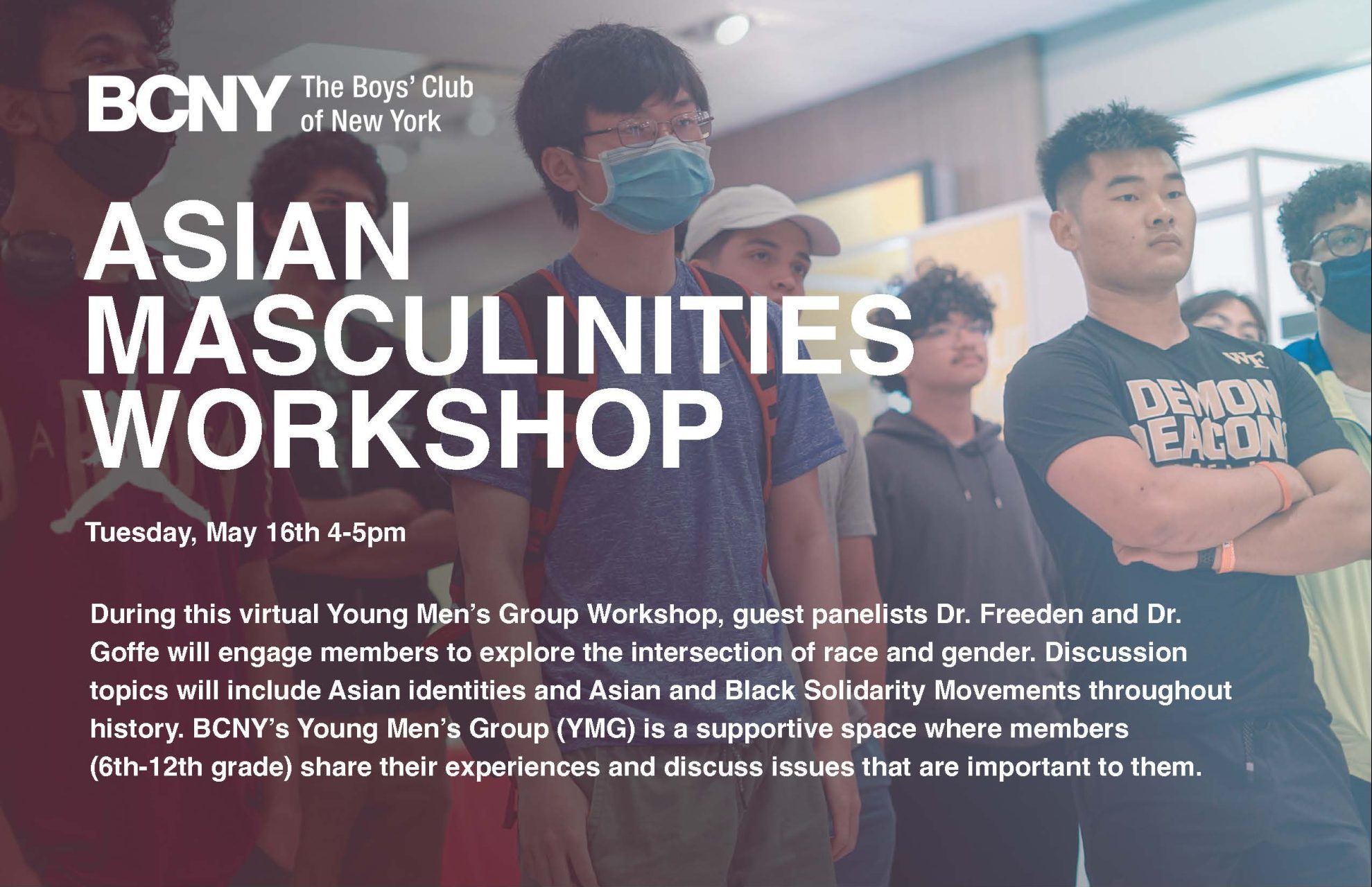
During this virtual Young Men’s Group Workshop, guest panelists Dr. Freeden and Dr. Goffe engaged members to explore the intersection of race and gender. Discussion topics included Asian identities and Asian and Black Solidarity Movements throughout history. BCNY’s Young Men’s Group (YMG) is a supportive space where members (6th-12th grade) share their experiences and discuss issues that are important to them.
Dr. Freeden Blume Oeur
Dr. Freeden is an associate professor of sociology and education at Tufts University. His scholarship examines issues around gender and masculinity, feminism, childhood, and African American intellectual history and politics. He is the author of Black Boys Apart: Racial Uplift and Respectability in All-Male Public Schools (2018) and, with C.J. Pascoe, co-editor of Gender Replay: On Kids, Schools, and Feminism (2023).
Dr. Tao Leigh Goffe
Dr. Goffe is the founding director of the Dark Laboratory, a collective on race and ecology where members develop stories using creative technology (VR, AR, XR, DJing, film, screenwriting). Dr. Goffe is also the Executive Director of the Afro-Asia Group, an advisory organization with the mission of creating spaces of collaboration between African and Asian diasporas on futurity, solidarity, and infrastructure.
Food, Heritage, & Identity
Members asked Doctors Goffe and Oeur how foods from their culture affected who they are now. Dr. Goffe thought about recipes her ancestors may have cooked during the pandemic. This led her to consider how Jamaican and Chinese people have rebelled against the dominant culture- through resistance and struggle as well as through recipes and parties. Food became a way of connecting with past prominent leaders like Malcolm X who ate meals rich with history and heritage as they traveled the world for revolution. Food from her Chinese and Jamaican heritage culminated in two major developments for Dr. Goffe: creating recipes for a cookbook (such as Jamaican fried rice) and the Afro-Asia Group.
For Dr. Oeur, food is a way to nourish as well as a language, a way of sharing, keeping, and preserving family histories and memories. Now that he has two sons, one of whom loves their grandmother’s egg rolls, Dr. Oeur can further see how food (and a recipe that he can’t seem to get quite right) connects their family’s heritage and histories. When reflecting on his days researching at a high school in Philadelphia for his book, Dr. Oeur discussed how the boys, whose favorite foods were Chinese fried rice, exemplified how food, like music and sports, is a cultural item that can be shared with members from many different groups, even if to some it may seem like it only “belongs” to one group.
Inspiration & Role Models
Members also asked about who inspired the speakers, serving as role models. For Dr. Oeur, role models and mentors come in so many different styles, and his mom and dad, for example, mentored him in very different ways. In the case of his mother, she taught him humility and the importance of taking note of little things, like the questions that spontaneously come to mind when daydreaming or attending an important workshop. These little jots in his notebook grow and serve as small pockets of time that allow him to remember the important thoughts that often slip by.
Dr. Goffe wanted to answer the question by thinking intergenerationally. Often, her philosophy is to be led, that you are on a journey that oftentimes you don’t know you are on, and you are where you need to be. So, it takes trust and surrendering to this journey. This comes up when she is cooking and thinks of her ancestors, such as her grandmother, and those we don’t hear about like her grandmother’s grandmother’s grandmother. Thinking of these ancestors and the moments of resistance and joy she will never know about fills Dr. Goffe with hope. Being led by all the ancestors she will never know is a source of power. Food passed down from our ancestors is a gift and gives a sense that we should not give up.
Asian & Black Solidarity Movements
Doctors Goffe and Freeden discussed with members the current parallels in Asian and Black Solidarity Movements- COVID-19 being hatefully attributed to Chinese people and the Black Lives Matter Movement protesting police brutality. Members mentioned how these stereotypes have negative effects on others and create misconceptions about groups of people. These stereotypes have historically been used to target groups’ masculinities, with anti-Black and anti-Chinese rhetoric in the late 1900s being used to negatively portray Black and Chinese men, for example. Drs. Oeur and Goffe it was important for members to know the connection between masculinity and solidarity movements throughout history, highlighting the importance of solidarity and connection to disrupt and overcome these stereotypes. Masculinity for all boys should be guided by the rich histories and heritage of cultures that connect and bring joy but should be aware of the negative pressures that come from stereotypes that try to box boys in.
Dr. Freeden saw how public education and its many issues, such as the problems with standardized testing, intersect with Asian and Black people. Dr. Goffe talked about how it took a pandemic and its subsequent stereotypes for many people to reckon with the Black Lives Matter movement, showing that these consistent issues often occur in tandem. The discussion then shifted to resistance and revolution- what has been done in the face of these issues in the past. Specifically, Dr. Goffe illustrated the interconnectedness of past Asian and Black solidarity movements through music. Soundtracks of revolution for Asian and Black solidarity movements over the centuries can be celebrated through listening to jazz artists like Miles Davis and Fred Ho. These celebrations convey hope and bring people who are different together.
We are so proud of our members for engaging in such an important workshop discussing the challenges of stereotypes and how they affect Asian and Black communities, as well as the unshakable hope that comes from our heritage and culture.